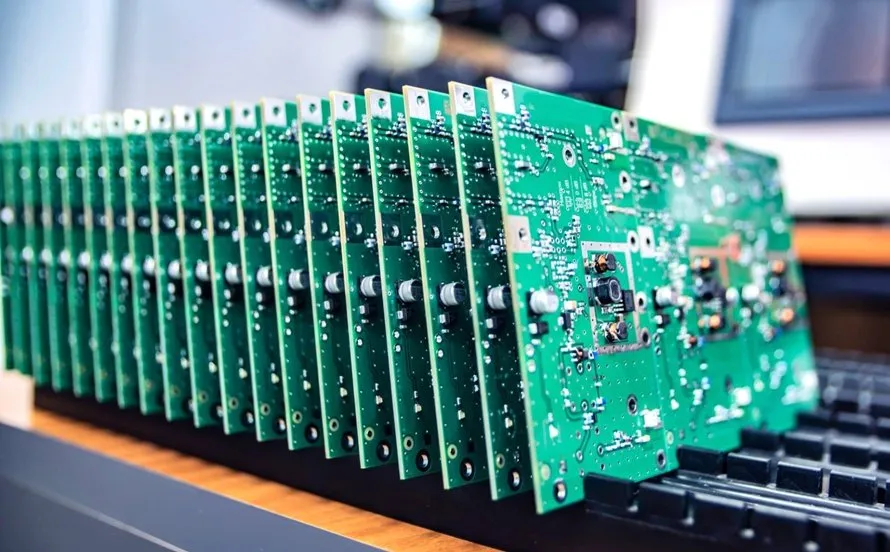
A customer once showed us what looked like an excellent Industrial IoT PCB Assembly design.
Honestly, our first reaction was, “This looks impressive.”
The product was designed for monitoring plant growth and environmental conditions in remote forests across Northern Europe. It collected temperature, humidity and other environmental data before sending everything back through an IoT network.
From an electronics perspective, the design looked modern.
The customer separated the display board and the main controller using a rigid-flex PCB. The idea came from an automotive project they admired. They told us they had studied Huawei’s programmable headlights and liked the way multiple boards were connected through flexible circuits instead of traditional wiring.
Technically, there was nothing wrong with that approach.
In fact, rigid-flex technology can reduce connectors, save space and improve assembly consistency.
But this wasn’t a car.
And that completely changed our recommendation.
Industrial IoT PCB Assembly Starts With the Real Working Environment
During later discussions, we learned something that hadn’t appeared in the original design files.
These devices wouldn’t be installed inside a factory or an office.
They would spend years in remote forests.
Some sites could only be reached on foot.
Maintenance teams might visit only once every six months, and each maintenance trip could take two full days.
That single piece of information completely changed how we evaluated the project.
In Industrial IoT PCB Assembly, reliability isn’t only about making products that survive manufacturing. It’s also about making products that can still be maintained years later when unexpected failures eventually happen.
Every electronic product will fail someday.
The real question is how difficult it will be to repair.
HUGE Forest
Why We Recommended a Simpler Industrial IoT PCB Assembly
The rigid-flex PCB certainly looked more advanced.
It also eliminated one connector and one wire harness.
For consumer electronics, that often makes perfect sense because products are compact and rarely repaired in the field.
This project was different.
If the FPC section were ever damaged by vibration, repeated stress or accidental handling during servicing, replacing it would mean replacing the entire PCB assembly.
That isn’t difficult inside a factory.
It becomes a serious problem when the nearest service location is deep inside a forest.
Instead, we suggested something that looked far less sophisticated.
We replaced the rigid-flex connection with two separate PCBs connected through a standard 8-pin JST connector and a common 16 AWG wire harness.
The enclosure had enough internal space, so there was no mechanical penalty.
More importantly, replacement parts would always be available.
Any technician could disconnect the harness by hand and install a new one within minutes.
No soldering.
No special tools.
No waiting for a custom rigid-flex PCB to arrive.
From a presentation standpoint, the original solution probably looked more impressive.
From a long-term maintenance standpoint, the simpler solution was actually more reliable.
Sometimes good Industrial IoT PCB Assembly is about choosing the design that will be easiest to support five years later, not the one that looks most advanced on day one.
16 AWG cables with 8pin connector
Industrial IoT PCB Assembly Also Depends on Material Selection
The enclosure design told a similar story.
The customer had designed a custom housing with an IP65 sealing structure.
That was exactly what we’d expect for outdoor deployment.
However, one detail hadn’t received much attention.
The O-ring material.
Forests in Northern Europe create a demanding environment for elastomer materials.
Humidity remains high for long periods.
Winters are long.
Temperatures can stay below freezing for weeks, while summer temperatures rise significantly during direct sunlight.
Over time, standard rubber compounds can harden, lose elasticity and eventually crack.
When that happens, the enclosure may still look perfect from the outside, but moisture can slowly enter the product and create failures months later.
Instead of keeping the original material, we recommended switching to a low-temperature, weather-resistant sealing material similar to those commonly used in demanding outdoor industrial applications.
The cost difference was relatively small compared with the overall product cost.
The potential reduction in future warranty claims was much greater.
Material selection isn’t always about using more expensive materials.
It’s about matching materials to the environment where the product will actually spend its life.
Forest in winter
The Best Industrial IoT PCB Assembly Decisions Often Aren’t Visible
Looking back, neither of our recommendations made the product look more advanced.
In fact, one of them did exactly the opposite.
Replacing a rigid-flex PCB with a wire harness isn’t something you’ll see highlighted in a marketing brochure.
Changing an O-ring compound doesn’t make the product look any different.
Yet both decisions significantly reduced long-term operational risk.
That’s something experienced OEM teams understand well.
Successful products aren’t judged by how elegant they look on a CAD screen.
They’re judged by how reliably they perform after years of real-world operation.
Experience Means Understanding the Product, Not Just the PCB
One lesson from this project has stayed with us.
Customers often send Gerber files, BOMs and mechanical drawings expecting us to review only the electronics.
It requires understanding where the product will be installed, who will maintain it, how often it will be serviced and which replacement parts will still be available years from now.
Those questions rarely appear in CAD files.
Yet they often have a greater impact on long-term reliability than the PCB layout itself.
Sometimes the best engineering recommendation isn’t making a design more advanced.
It’s making sure the product will still be practical to maintain long after it leaves the factory.
Conclusion
Every Industrial IoT PCB Assembly project has its own priorities.
For some products, reducing size is the most important goal.
For others, lowering cost or increasing performance comes first.
For equipment deployed in remote outdoor environments, maintainability and long-term reliability often matter even more.
In this project, choosing a standard wire harness over a rigid-flex PCB and selecting a more suitable sealing material didn’t make the product more complex.
They made it more practical.
And sometimes, that’s exactly what experienced manufacturing partners are expected to do—not simply build what appears in the design files, but help ensure those designs continue working reliably in the real world.